The science
of silence
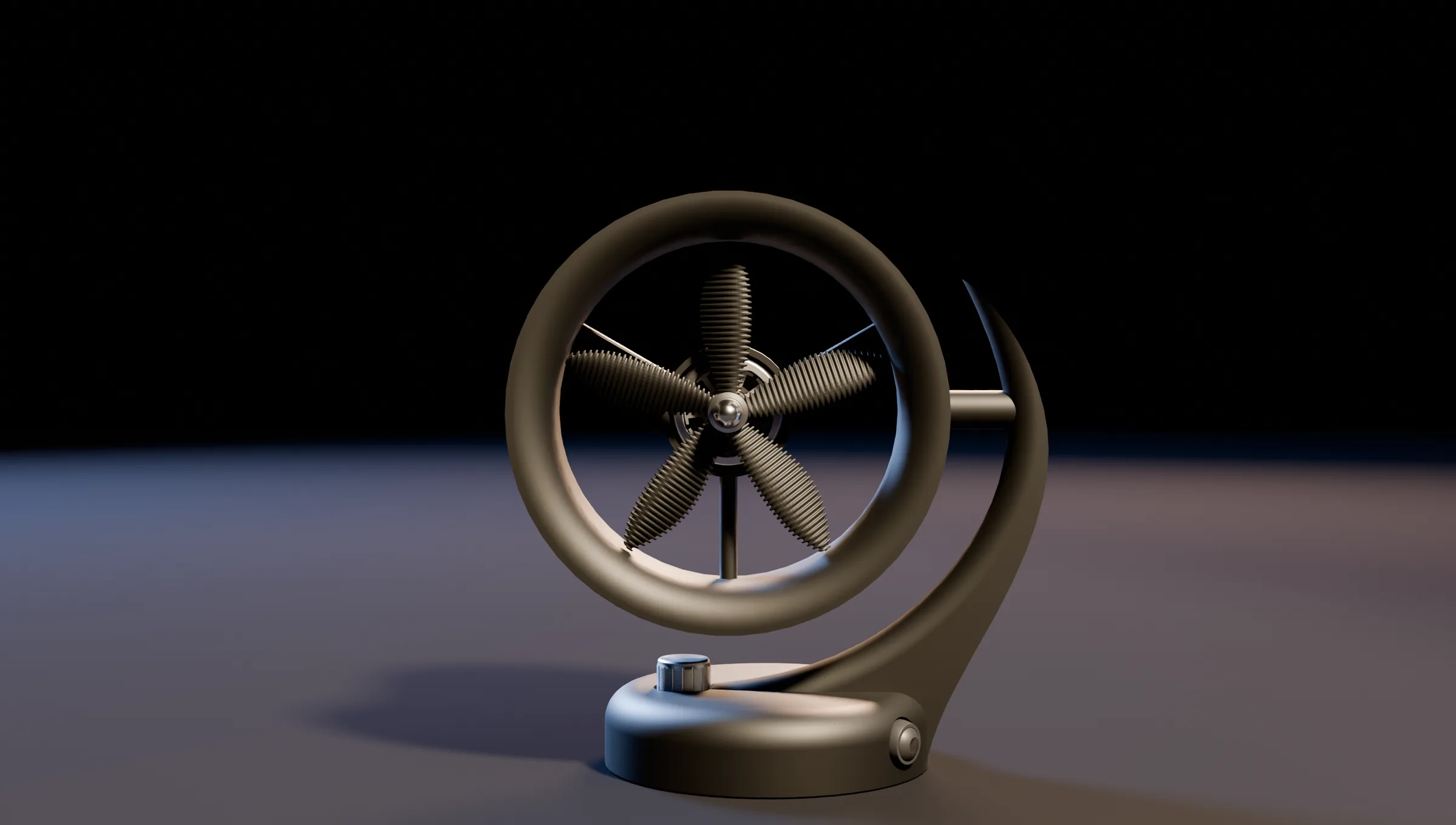
The desk fan that learned to be quiet — by copying the owl's wing. Up to −16.5 dB, without sacrificing airflow.
The owl hunts in perfect silence. Its wings break air vortices before they turn into noise. We carved this secret into a fan.
Silence,
by design.
Noise is treated at the source — through part geometry and material choices, validated by research.
Drawn by research.
Half of a fan's noise is born where air meets the blades. The Ventilencieux impeller adopts a design published in Nature Communications — a cicada-wing outline with 3D serrations inspired by owl feathers — and the whole shroud is profiled to guide air without crumpling it.
- 3D-SC blades: −5.5 dB measured against the industry reference
- Bell-mouth inlet: the flow is smoothed before it reaches the blades
- Nose cone and diffuser: up to −7 dB versus a flat hub
Every part chosen against noise.
Over twenty materials compared, four selected: a carbon-fiber PETG structure that won't vibrate, a TPU joint isolating the motor from the base, an impeller printed in high-precision resin. And a brushless motor driven with sinusoidal currents — its commutation is inaudible.
- PETG-CF: the stiffness that cuts parasitic vibrations short
- TPU 95A: the motor's energy is absorbed instead of transmitted
- SLA resin impeller: the surface precision aerodynamics demands
Slide to listen.
Spin it in your hands.
Everything, to the detail.

Silence,
at your fingertips.
A mobile app that talks to the fan over Bluetooth Low Energy — fluid, immediate, seamless.
- Instant BLE connectionScan, pair, and control over Bluetooth.
- Smooth regulationSinusoidal currents from the FOC driver: inaudible commutation and a gentle ramp-up, without acoustic jolts.
- App and knob, in syncApp control is coupled with the potentiometer on the base: both stay consistent at all times — fluid control, by hand or on screen.